
Stow, Massachusetts
.jpg)
The First Period house, as it was in the 1920s under the care of Eliphalet Tenney. Photo from Clara Endicott Sears's Days of Delusion (Boston: Houghton Mifflin, 1924).

Tenney House on September 20, 1935. Photo by Harriette Merrifield Forbes, courtesy American Antiquarian Society.
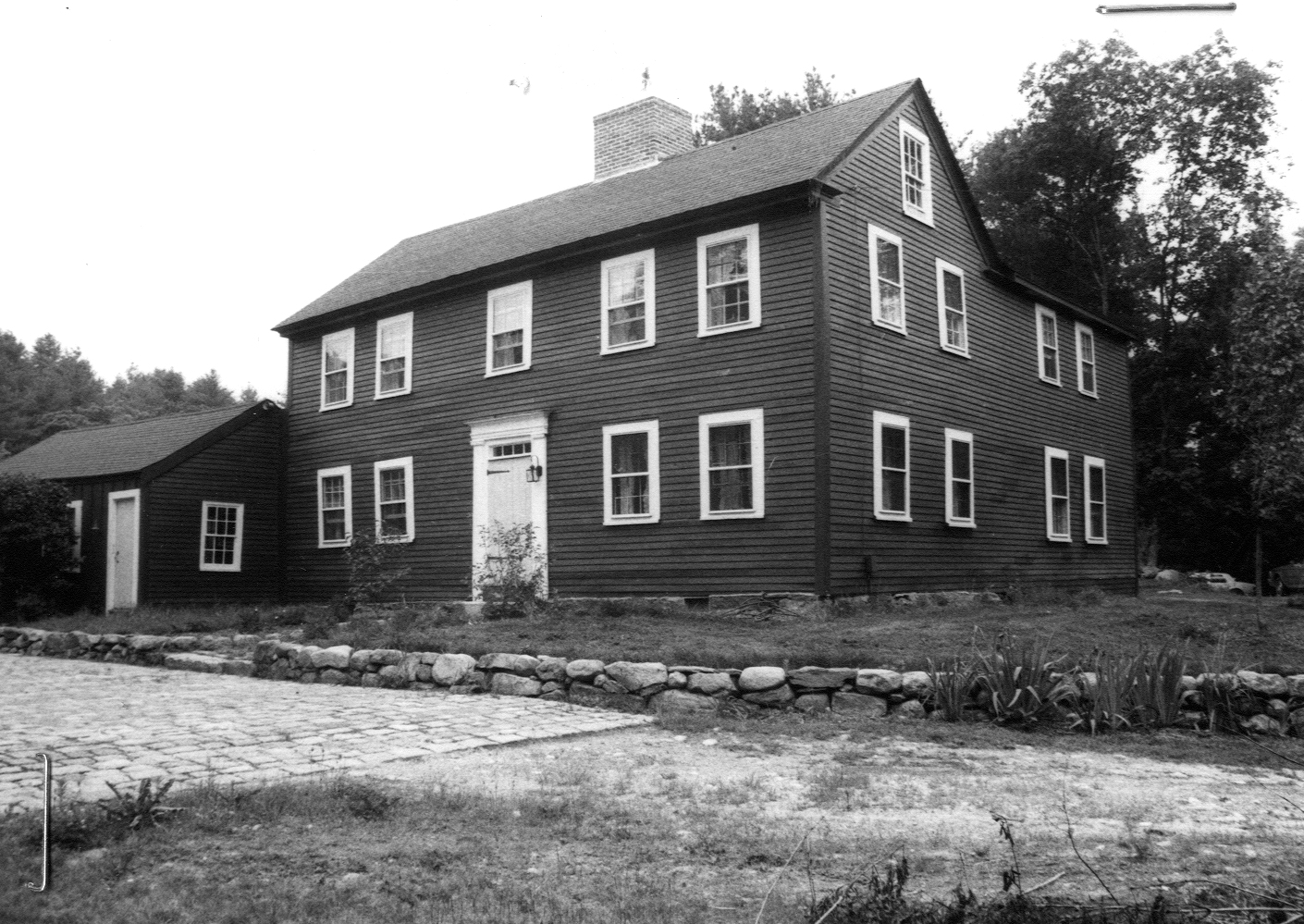
Tenney House in Aug. 1985, a few years after a second storey was added to the rear ell, covering the top of the secondary chimney. Photo by Nora P. Small for Massachusetts Historical Commission's First Period Buildings of Eastern Massachusetts Survey, 1985.
The homestead began as a Massachusetts Bay colonial farming, pasturage, and woodland tract with dwelling house, owned by the Holman family during the 18th century, the last being Cpl. Samuel Barnard (1747–1799), Jeremiah Holman's maternal grandson. Barnard, his wife Susanna Sargent (1750–1801), and their children removed to the township of Pepperell by 1780, selling the Stow title to Eliphalet Tenney (1731–1813) and wife Eunice Boynton (1738–1816) of Newbury, Essex Co.
The property would then remain in the Tenney family for over one hundred and fifty years, inherited and farmed by Moody Tenney (1779–1848) and his wife Anna Bent (1780–1859), their son Jason Bent Tenney (1818–1856) and his wife Sarah Pillsbury (1819–1881), and their son Eliphalet "Life" Jason Tenney (1851–1933), the last of the named Tenneys to work the land. The deed was bought in 1931 by George Jason Stow (1870–1952), Eliphalet's maternal nephew through his sister Judith Ann Tenney (1841–1912), and some years thereafter sold to owners outside the family.
Further Reading